
 No one should have to worry about whether they will have food on their plate or a roof over their head.
As the holidays approach, people take time to consider what they’re thankful for and many choose to donate some of their time, attention, and resources to others. In that spirit of giving, each year the National Coalition for the Homeless and the National Student Campaign Against Hunger and Homelessness sponsor Hunger and Homelessness Awareness Week during the week prior to Thanksgiving. EVERY PERSON DESERVES TO LIVE without worry whether they’ll have food on their plate or a roof over their head. But instead, far too many people are forced to make hard choices between paying for food, housing, and other critical expenses. In the United States
Worldwide
Join together to fight poverty As a society, we have the resources and knowledge to end hunger and homelessness, we just need the collective will to make these ideas a reality. Nov. 12-20, 2016: Join together with people across the country for Hunger and Homelessness Awareness Week. You can lend a hand to those in immediate need, while also supporting long-term solutions. What you can do
Learn more about how to help @ HHWEEK.ORG
0 Comments
 Unleash your creative juices and find inspiration in the least likely places. In today’s 24/7 work culture, it’s hard to get away from the office and recharge our batteries. John Donahoe, Chairman at PayPal, takes a "thinking day" every few months. "These are pre-scheduled, uninterrupted times to step away from the chaos, zero-base my time, and refocus on the issues that are most important."
When we have a relaxed state of mind, we are more likely to turn attention inwards, able to make insightful connections. Do you notice moments of inspiration and problem solving appearing out of the blue? For me, it’s in the shower, taking a walk or driving my car. According to Psychology Today, “The creative process springs as much from the subconscious as it does from a conscious thought process. Most often, creative solutions are not wrestled from your mind through sheer force of will. Eureka moments tend to occur spontaneously, almost always when the conscious mind is thinking of something else, or nothing at all.” Design Director Damon Nakagawa was asked where he finds inspiration. “I’m inspired by architecture: both the process and the product. It’s that overlap of science and art and designing for human needs, comforts and aesthetics that really has fueled me as a designer. Other things that inspire me are unplugging from the electronic world—gardening, cooking and camping—creating music and spending time with my family.” Of course, there’s no substitution for taking a legitimate vacation to help you feel fully relaxed, renewed and refreshed. According to Mr. Donahoe, “Cutting off email and the Internet can be stressful in the beginning, but it can become a very liberating experience. Without a constant barrage of work issues to respond to, your mind can calm down and your intuition becomes alive. You are able to see things through a more creative lens and new ideas often emerge from taking time off.” Whether you take a vacation or a “thinking day,” it’s important to take a break, relax, and get inspired. It’s time well spent.  Create a corporate giving program that aligns with goals and engages the community.
One of the most important things you can do for your business is to establish a corporate giving program. This type of program offers multiple benefits: it can increase your exposure and reputation in the community; it can boost employee morale, making it easier to recruit and retain top talent; it can have tax benefits; and it can provide you an opportunity to partner with your customers, suppliers and community, which is always a good thing. Engaging your employees Employees will be key to the success of your program and should be involved in creating it. Here’s a five-step approach:
Structuring the program You’ll need to decide how to structure your program. Here are some common ways companies donate (select one or all of them):
Determining the budget Knowing how much to donate, and what’s appropriate for a company your size, may be the most difficult part of creating a corporate giving program. Start by researching what other companies similar in size, revenue and industry are contributing. A great resource for this type of information is from the Giving in Numbers, 2015 Edition. It’s an annual report developed by the Committee Encouraging Corporate Philanthropy (CECP) in association with The Conference Board. It can be downloaded for free and incorporates data from 271 companies, including 62 of the largest 100 companies in the Fortune 500. If you don’t have the funds to contribute your full target amount your first year, develop a three- to five-year plan that will get you there over time. The important thing is to get started, and I hope these steps will help you.  Stories have captured our imaginations from childhood through adulthood. They have taken us on exciting journeys, taught us new lessons and made otherwise dull facts into something memorable.
Storytelling has become a powerful communications tool and an integral part of how businesses are telling their brand story and connecting with their audiences. Everyone loves a good story How is your product or service important in the lives of your customers? A good story is authentic, creative, makes an emotional and personal connection, inspires action, and takes an audience on a journey with your brand. Your purpose for story telling is to create a memory. One of my favorite teachers in high school was a great storyteller. Instead of having us memorize fact and figures about world history, she brought the events to life by sharing exciting stories that we remembered. In the same way, creating a memorable story about your brand is the best kind of story to share. Facts not fiction Whatever your brand story, it needs to be based on facts, not fiction. Not to say that you can’t illustrate your point creatively, but exaggerated fish stories are not allowed. You should never mislead anyone about what’s true and what’s not in your story telling. Your stories need to be rooted in the reality of your brand, products and industry. Mastering the art of storytelling Just like any fictional story, your brand stories should have three parts: the situation, the conflict and the resolution. Open strong by establishing your story setting and introducing the characters. In the middle, you should be setting up your main character’s problems and present conflicts that he or she can resolve in the end. It is important to make sure that your audience doesn’t feel manipulated, but gently led down a road that arrives at the desired destination. Allstate Insurance My husband has worked for Allstate for most of his career. When the company introduced the anti-hero “Mayhem” in a 2010 national television campaign, it got our attention. By depicting the uncertainties of everyday life, the advertising reinforced, in a humorous way, why consumers need the protection of Allstate insurance. “Mayhem," played by Dean Winters’ has become one of the most recognized brand characters in the country. Telling your story When telling your story, your main character should be a client, employee or brand character with your company serving in a supporting role that offers tools to help the main character create successful resolutions. For example, if you are trying to increase participation in the company 401(k) plan, the story should focus on how the benefits have led to real-life impacts in the lives of employees. Concentrate on one or two recipients, illustrating their situation, the conflict and the successful resolution. A powerful way to demonstrate customer loyalty is through the use of testimonials. They need to be more than a few sentences, or they will be forgettable. You’ll need a story that highlights a customer’s personal challenges and then illustrates how the company helped solve them. The positive outcome will stay with your readers longer than any marketing material. As I reflect back on the past few months, I am thankful for my family, friends, colleagues, and clients who have supported me both personally and professionally. I feel truly blessed. For each new morning with its light, I'm wishing you a day filled with love, laughter, and lots of food! Happy Thanksgiving!
 I don’t know if you’ve noticed, but LinkedIn has gone through a major transformation over the last few months. Yes, it continues to be the number one business-networking site, but its value reaches beyond posting jobs and resumes.
You can use LinkedIn to create and shape a social environment to support you and your company’s objectives. Here are a few possibilities:
Getting started Identify your audience. Who do you want to reach? LinkedIn has over 225 million users; who should you connect with and why? Answering those questions will help you focus on connecting with people and organizations that are important to you. Tell them what they want to know. This is a business site and people are interested in information that matters to them. Choose topics that educate, inform, and help solve their problems. Join group discussions. Search for groups that are relevant to your industry and those of your targeted audiences. Participate in the discussion by giving your opinion or insight on a specific topic. This builds your reputation as a subject matter expert and gets you noticed. NEVER promote your company or your services during group discussions. It will be considered spam and you could be asked to leave the group. Instead, talk about relevant topics and provide information that benefits your audience. Create a company page. LinkedIn allows business owners to create company pages to promote their products/services and interact with their followers. It’s fine to talk about your latest client success and company news; although, do it in moderation. People can appreciate self-promotion occasionally, but will be turned off if it’s more than 30% of the time. Engage, engage, engage. There’s a debate on how often you should be updating your status. It really depends on how serious you are about using social media to help you reach your objectives. Minimum interaction should be 3-5x week. Post updates on your company page weekly, but only if have something relevant to share. Whether you are hunting for new customers, connecting with your industry, spreading your marketing message, or looking for information about someone or something, we recommend tapping in to the power of LinkedIn.  I’m on Twitter every day and was a little confused when I started seeing the use of MT instead of RT in front of tweets. Here’s some clarification on the two abbreviations.
If you “Modify a Tweet,” the proper protocol would be to use “MT @username:” prior to the message. This lets the reader know that you made changes to it. If you are forwarding a tweet without making changes it is considered a “Retweet,” and “RT @username:” is the standard format to use. How much modification justifies an MT? If you are just changing a couple of characters to save space, and not changing the tweet substantially, then you may stick with a RT. If you begin to shorten a tweet significantly or change words, then you should go with MT instead. Twitter etiquette is more than just learning a few key terms. In future blog posts, I will cover commonly asked questions about social media culture and etiquette. Do you have a question you would like me to answer? Ask in the comments section. Happy tweeting! 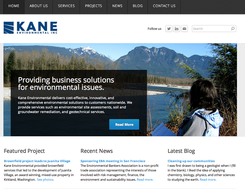 We are excited to announce the launch of a new website for our client, Kane Environmental.
As the company continues to extend its reach and expand its services, they needed a website that effectively communicates who they are and the expertise they offer their customers. Visitors to the site will have quick and easy access to information on everything from their capabilities to career opportunities to the latest Kane news. They even have a blog! We began the project in mid July and worked closely with Kane's marketing team to write the content, select the photography, and build the site. Last week, I read a post by John Donahoe, CEO of eBay, about how he takes a "thinking day" every few months. "These are pre-scheduled, uninterrupted times to step away from the chaos, zero-base my time, and refocus on the issues that are most important."
He shared valuable lessons-learned and insights that not only apply to business leaders, but to all of us. Aren't we all CEO's of our lives? Don't we all need to take a "thinking day" (personally and professionally) to step back and evaluate our priorities? Excellent article about how environmental remediation improves the quality of life in our communities. While it’s fair to say that soil remediation isn’t the sexiest process in the green industry, it’s a real necessity. The process focuses on extracting and treating soils to remove pollution and other issues. Soil remediation is a responsible decision that can help to improve the health of employees and neighbors. It creates a safer workplace environment by reducing the risk of exposure to harmful pollutants. The process also helps preserve the health of community overall. To learn more about the important role soil remediation plays in the green industry, read the entire article at GreenerIdeal.com.
|

Karen Weber-MillsteinSharing my thoughts, industry insights, and recent client successes. I would love to hear what you think. Archives
November 2016
Categories
All
|
 RSS Feed